Julia Mira
  • Home
  • Forest
  • Derelict Vehicles
  • People
  • Chickens, Fish, Etc.
  • Outliers
  • Drums
  • Artifacts
  • About & CV
  • Contact
  • Blog
  • Straw Weaving

Interlude: Hasty or Effective and Efficient?

11/20/2010

0 Comments

 
One cultural difference that surprised me is the speed that things happen at. I seem to need more time to absorb things than is allowed for around here.


A kindly host will see that I'm drooping and say, "Do you want to rest for ten minutes?" No, actually. I want to rest for an hour. Or an afternoon. I hardly know how to begin resting in ten minutes.


Japan is the only place I've visited where people eat more quickly than I do. The food arrives. I cradle my teacup in my hands, and as I take the first sip, glance up and see that everyone has inhaled their meal and are politely waiting for me to begin.


Speaking of eating, meals are served with individual plates for each different flavor. So, you can end up with a stack of seven or eight plates by the end of the meal, more if you have gone to a high-end restaurant. But the chopsticks are almost always single-use disposable. Imagine a nation of 127 million people using three pairs of chopsticks per day and tossing them! I asked why people don't have lovely designer chopsticks, just like their lovely plates. The answer? It would be too much work to wash them for each meal.

Electronic multitasking is taken for granted. Cars have TV's and GPS on the same screen, and it is not uncommon to be driven by someone who is switching back and forth between TV and GPS, texting on their cellphone, and trying to chat in a foreign language. Answering a cellphone during conversations is common and one of the few things that doesn't merit an apology.

At the school, after a short conversation about what would be a good lesson for the day, we're asked to summarize the options in a sentence apiece, with time needed. I seldom know the answer, since I don't know what the parameters are. There is a pattern to when things need to be exact and when they can be sloppy, but I don't know what it is yet.

When I return to school this coming week, I've been asked to do a few crafts workshops. About an hour apiece. For origami, maybe I could do that. But for card weaving? Drawing? A sewing project? Hard to imagine.

Sightseeing is accomplished at breakneck speed. I like to poke around, stop to sketch, wait for a serendipitous event. In a group, with a tight schedule, that's simply not an option. We arrive, sweep the area, and we're outta there. I find that it is indeed possible to gather the essential feel of a place that way.

English lessons are a strange combination of intense and superficial. Instructions are in Japanese, even though that's a clear-cut place where English could be taught and used. Individual grammar or vocabulary points are mentioned and then we're done. I think that students are expected to take notes and memorize the material later, but the fact that even after years of instruction few people are that fluent indicates to me that more classroom time in English would be a good idea.

One good thing about all this is that in order for things to work this way, they have to work. I haven't noticed anything that's broken. Problems are addressed at once. If I mention that I'd like more fresh food, we veer off to the grocery store and get some. We asked about adapter plugs and bam, we went to three electronics stores until we found one, and only then went back to the day's sightseeing plan. It is common to slide in to the train station with exactly enough time to buy the ticket and trot through the various checkpoints. The train will arrive the moment the schedule says it will, and leave half a minute later.

Word of the day: soro-soro: Let's get this show moving, folks!

Picture
0 Comments

Nov 20: Ueno Park, Tokyo

11/20/2010

0 Comments

 
For the first time, Camilla and I are unescorted. We're staying at the Andon Ryokan in the Minowa District of Tokyo. It's a well-designed budget hotel. The rooms are teeny tiny but there is a hot tub, a washing machine, and Internet access. By noon we were ready to brave the city. We walked along a teeming street to the subway station, bought our tickets at an automat, and went two stops to Ueno Park. 

But where was the Park? There were zillions of people, lots of noise from overhead trains, and masses of cement walks, pilings, walls, and buildings. We wandered around and found an open-air market under the elevated train tracks. It was crowded, noisy, and had lots of unfamiliar smells. We ducked into a department store, which had shoes that called out to Camilla. But she is size Monster, and the shoes in Japan only go up to size 7, apparently. So, back out to the ferocious noise. 

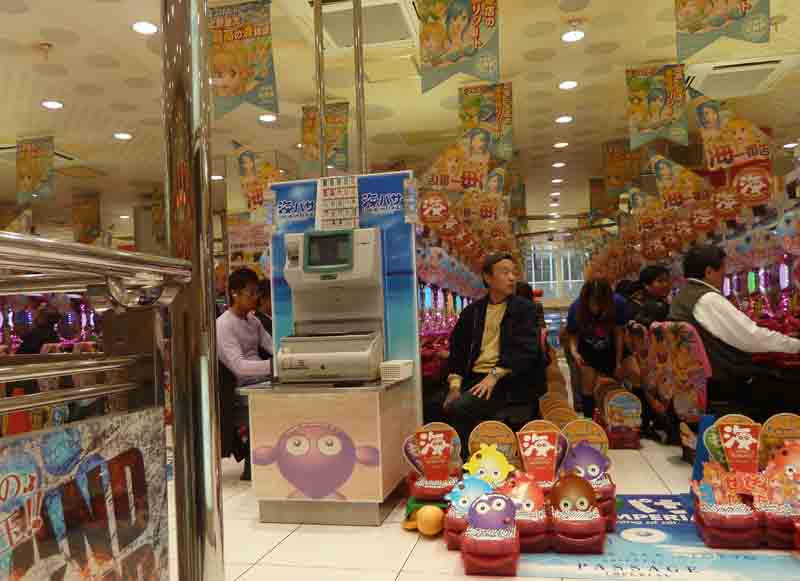
Speaking of ferocious noise, I invite you to return to this post after I upload the film Camilla made of the inside of a pachinko parlor. THAT is noise. Lights flash, attendants run around with baskets of ball-bearings, and there is an excited roar of music and general din. We poked our noses in for about a minute, and when we withdrew, the real world seemed dull and poorly lit. 

The market had barkers, fish stands, acrylic furs, noodle shops, candy stores, keychain stores, and mystery zones. We had a lousy lunch of tempura, then plunged back in to the fray. The kimono stand caught our attention for a long time, but without Tokiko-san to make pronouncements, we felt unable to buy anything. Camilla bought a 200 yen ($2.50) kebab of four strawberries, and we headed for the park.

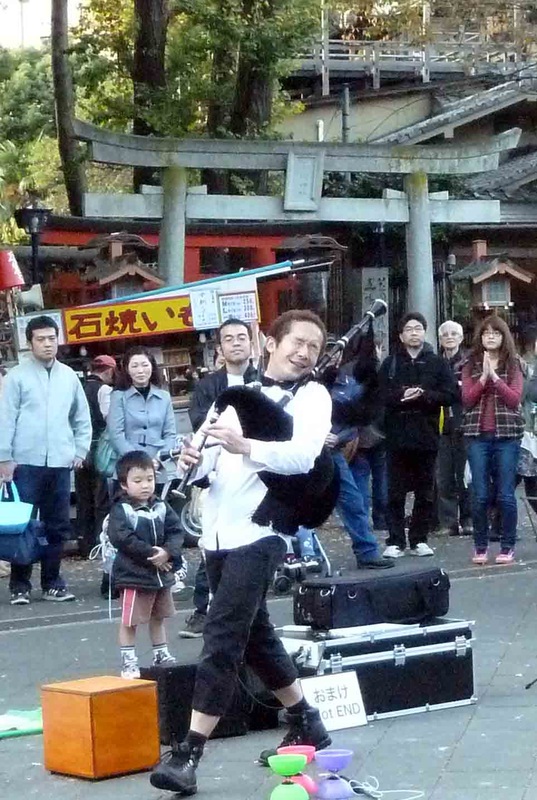
It is lovely. There are trees everywhere, and the landscaping is characteristically Japanese, with large rocks and water features here and there. Also for the first time we saw homeless people, quite a few of them, with cardboard beds and rags for clothing. They were fairly reserved, no panhandling and people ignored them. I wonder how they eat. There were street performers, including a mime who played a pretty good bagpipe. 

We have become shrine aficionados. There is something really appealing in the architecture. Usually you have stairs leading up to the place, and a red gate with a straw rope hanging from it. Two stone dogs, dragons, or foxes stand at either side of the gate, and then the shrine itself can either be a simple country hut or, as they were at the park, a commercial operation with a brisk business in charms and prayer papers. Each has its own flavor, and we veer towards every one we find.

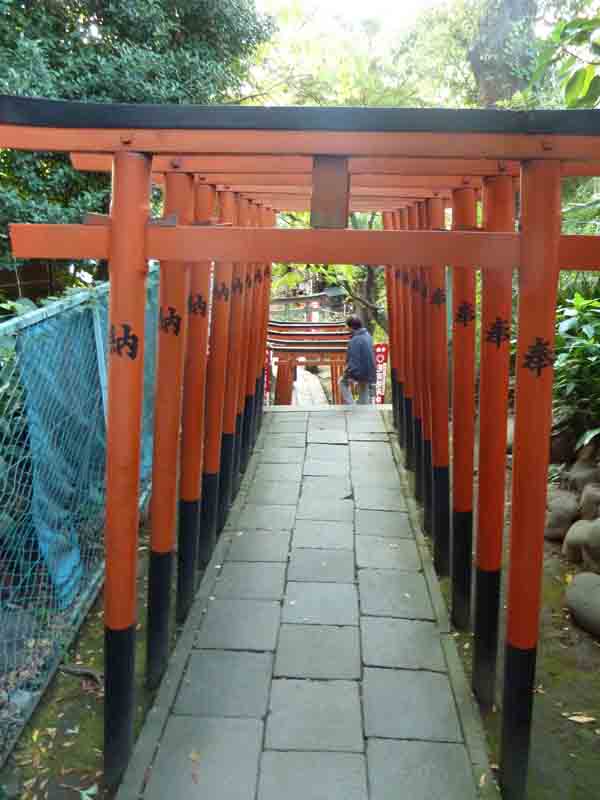
The second one we visited at the park was especially interesting. Maybe 30 red gates lined the stairs, don't know why. The shrine itself was in a grotto, with candles and ceramic foxes everywhere. A little creepy, a lot appealing.
We finally found the Tokyo National Museum an hour before closing time. We went to the building that is full of national treasures like old kimonos, scrolls with calligraphed sutras, samuri costumes, Chinese lacquer plates, etc. Then to the bookstore, of course.

It was dark so we trotted back to the subway and, after a few minutes, figured out which kind of ticket to buy. Got the tickets, got on the subway, got off the subway at the correct station, went out the wrong door. Where is everything? We wandered off in all directions until we found a familiar landmark, oriented, and headed back to the ryokan. Dinner from the 7-11; aloe yoghurt, pasta, and green tea ice cream. Mmm.

Finished off the day with a long political conversation with some New Zealanders. I love hostels!

Word of the day: ju: Confucian scholar, go in.

0 Comments

Nov 19: Futarasan Shrine

11/19/2010

0 Comments

 
After a breakfast of eggs, bacon, and daikon, we all went outside to see Mt Fuji in the distance, snowcapped and perfect. Closer by, there was Nikko Mountain. The Kuman family enjoys hiking and so they could name every one of the mountains on the horizon.


Tsuyoshi-san took us to say good-bye to his parents, and then we were off to the Futarasan Shrine, just over an hour away. We went through beautiful countryside, with kitchen gardens and rice paddies in every empty city lot, and rice paddies and covered strawberry patches in the outskirts. The foothills were sprinkled with scarlet Japanese maple (momiji) and other fall colors. We passed the university where Tsuyoshi-san is somehow involved with a project to find gravity waves. He makes, I think, membranes able to withstand super cooling. They will shoot laser beams between very flat mirrors 3 km apart, and a gravity wave will perturb them.


Futarasan is in a complex of buildings where the Shogun used to have a summer vacation home. It is a harmonious collection of Shinto buildings, each lavishly decorated with carvings and painted wood. Yes, it's a World Heritage site, but it is not a museum. Most of the people who crowded the area (seemed like about 5,000 of them) went as pilgrims as well as tourists. You could buy good luck charms, light candles, get lectures by monks, be blessed by paper pom-poms, wash your hands, tie paper prayers to trees or wooden ones to special stands, and generally act pretty much like you might act in a Catholic cathedral. We climbed stairs, took pictures, climbed other stairs, looked at ceilings, and were delighted. 


We got a picnic lunch at a 7-11 and drove up a hideously winding road, the Irohazaka, to a lovely lake ringed by volcanoes, a snow-capped peak, hot springs hotels, and a shrine with real live monkeys. We didn't see the monkeys up close, but there they were across the road and up the mountainside, chattering at each other. Wow!


During all this, there was considerable behind-the-scenes concern on our behalf. How would we negotiate a Tokyo train station when it was time for us to go to our next destination? Phone calls flew thick and fast, while Camilla and I blithely gawked at the amazing sights out our window. 


Finally, Tsuyoshi plonked us on the fast train to Tokyo, and when we got off, a friend of a friend of a friend was there to meet us. Terri had taken her evening off to usher us down, around, through, around, down, and around to catch the subway to the Andon Ryokan in a rather seedy part of Tokyo. It took us some time to find it, and by then we had asked Terri to dinner. That took some time to find as well, and we feel we have a new friend. Finally, a hot tub and then bed.


Word of the day: ryokan: guesthouse
0 Comments

Nov 18: Pottery Village

11/19/2010

0 Comments

 
Aunt Shigeko and her daughter-in law and baby granddaughter took us on a tour of Mashiko, a pottery village, today. It was a pleasant little place, with narrow streets and small kitchen gardens everywhere. We visited one showroom after another, all with lovely tea bowls, tea sets, and sushi plates. A highlight for me was a climbing kiln, an enormous thing. It had maybe 8 ware chambers, each large enough to walk into and load pots on shelves. They climbed about two feet for each chamber, and so at the top there wasn't a chimney, just a set of ceramic cylinders that vented out into the air. You load enormous amounts of firewood, first into the topmost chamber, and then successively into the lower chambers until the whole thing is roaring. The brick walls of the chambers were melted.


Lunch was at a restaurant at the end of a long dirt road, a buffet followed by fish and rice, then dessert. Once again, I was amazed at watching these very slender, short people pack away enormous amounts of food and then bounce up, wondering how much dessert they could order with the set price.


After our tour, we went to a little workroom where we each threw three pots of our own on electric wheels. This was a jolly experience, with much laughter and miming. There was an American shorthair cat who presided over the operations and made sure she got sufficient attention.


Dinner was at home, with eight people around the kotatsu, two gas frying pans, and an enormous amount of meat, vegetables, and noodles that you could drop into the bubbling soy sauce and cook. We hung around afterwards, sharing photos and enjoying each others company.


Word of the day: kotatsu: some homes have a table with a second top. You sandwich a blanket between the two tops, which hangs down over your legs. The floor under the table is sunken and there's an electric heater down there. Handy in an unheated house with paper walls in November!
Picture
0 Comments

Nov 17: Weaving

11/19/2010

0 Comments

 
Aunt Shigeko drove us from the train station to her parent's house in Moka City. It is a crowded, lovely old house, with tasteful Japanese artifacts interspersed with the debris of daily life. There was a hysterical poodle, who ended up in a kennel, and a kotatsu in a tatami room. We sat around the table with our feet on the heater, drinking tea and wondering what to say. The two elderly Kumans are friendly and gracious, but with no English. Mrs. Kuman made valiant efforts, though. She spoke to us in Japanese, and if we didn't understand, tried a different way. It might sound hopeless, but that kind of persistence actually kind of works. 


Suddenly, we were off! We arrived at an old-fashioned cotton weaving mill. A cotton plant grew in a pot at the entryway, and you could see wooden hand spinning wheels, a kitchen where they use natural dyes, some skeins of drying cotton thread and some baskets of goldenrod, indigo, and mystery plant. Upstairs has a room with 50 little looms where visitors can make their own coasters. We were invited to try, by our translator, a very funny middle-aged woman who made rude suggestions while bowing politely. After we were done, minions finished off the coasters and slid them into plastic wrappers, which, they said, adds 30% to the selling price. Then we toured downstairs where the working looms are, pretty much the same 16 inch width (this might be half a meter). Most of them were empty, but one woman was warping a loom and another was weaving an indigo and brown pattern that we later saw in the gift shop.


The mill was attached to an old house, built, I think, by a defeated noble family turned merchant. They entertained Lord Date of Sendai, an old friend of ours familiar from the visit to the masoleum site in Sendai. The building was wood and paper, with a dark corridor surrounding a central tatami room with screens, alcoves, and low, ornate tables. Mr. Kuman suddenly said (his first words all morning) that my father had sat at one of those tables across from two geishas, and, thinking he was a young man, tried to out-drink them with sake. I was suddenly very moved by the story and by the sense of all the ceremonial and friendly activity that must have happened over the centuries in that room.


We rushed off to a department store, had melon sodas, and then to a Korean all-you-can-eat diner where we met more of the Kuman extended family, including three soccer-playing boys. We ate until we could hold no more, and then a little bit more. "Don't you like the food?" we were asked. "Why aren't you eating?"
0 Comments

Nov 16: Pottery Village

11/19/2010

0 Comments

 
Today Nishijima-san decided to take Yayoi, Camilla, and I to a pottery village 90 minutes away. Statues large and small of the tanuki, or Japanese raccoon, are everywhere en route. I quote here from Wikipedia: The eight traits are: a hat to be ready to protect against trouble or bad weather; big eyes to perceive the environment and help make good decisions; a sake bottle that represents virtue; a big tail that provides steadiness and strength until success is achieved; over-sized testicles that symbolize financial luck; a promissory note that represents trust or confidence; a big belly that symbolises bold and calm decisiveness; and a friendly smile. Sure enough.


We wandered around a pottery school which takes students from around the world, as well as artists-in-residence. The pottery on display was okay, but what really intrigued me were the old fashioned kilns, or kama. There were several types built into the hillside, ones with single chambers, divided chambers, and a set of climbing chambers. Each uses fantastic amounts of wood, which comes in little 12 x 12 x 18 inch bundles. Three to five hundred bundles is a typical firing amount.


There was a museum, with a useful side that had the usual tea bowls and umbrella stands, but also a kind of interlocking brick on which you can grow moss. The video showed some buildings faced with this brick, which looked green and friendly. 


On the traditional arts side of the museum, we saw the heavy glazes and rough pots that make the characteristic style of the region. They were beautiful and ugly at the same time, the wabi-sabi style. I was particularly taken with a heavy round pot with a heavy white drip glaze that had iridescent, purple, yellow, and green patches. Nishijima-san said that he was glad to visit the museum because examples of work done by potters who are ranked higher than he is are there, and because of their rank, he can't visit their studios to talk to them, he has to find other ways to see what they're doing.


We had a rather unfortunate lunch at Lake Biwa, the largest lake in Japan. Then, back to Kyoto, where we took the romantic maple-leaf-viewing train along a river gorge. It was lovely, of course, but there was also the added thrill of being on a very old train with crowds of noisy sight-seers who were carrying on a hundred-year-old tradition. In 1920, the whole scene might have been pretty much identical.


Back in town, we looked through various stores for an electrical adapter, then met one of the taiko drummers for dinner at a small stir-fry restaurant. The chefs invited us to see what they were doing. They chopped up an entire head of cabbage, then added other ingredients, and stirred busily away. Their ferocious looking mustaches and head scarves, combined with nervous giggles was an interesting contrast. The food was really good, but far too much of it. "Don't you like Japanese food?"


We then drove around town in a mad effort to find either an onsen or Jason, ending with a birthday party for Jason that lasted well into the morning.


Word of the day: Tanuki: Japanese raccoon, a cute trickster figure in mythology.
0 Comments

Nov 15: Arrangements in Kyoto

11/14/2010

0 Comments

 
This morning is full of questions. Will we go to the parent meeting at Yohane School, or will that just whet the parents appetites and make them question why the school doesn't have people like us full time? Will the multiple train change to visit Tomo's family outside of Tokyo be possible for inexperienced travelers? What exactly are we doing after the 19th? Will we be able to meet Yoshie? What about Alan? And what will happen right before our departure? Also, we need a new suitcase to fit all the kimonos and pottery that we have been given. Can we find a used suitcase store without spending a stupid amount of time on the task? All these questions plague the mind. In the mean time, Camilla and Yayoi are out buying bread and I just finished all the blog posts below. In a few weeks, I might post some pertinent photos to go with the posts, but for now, it's up to date.


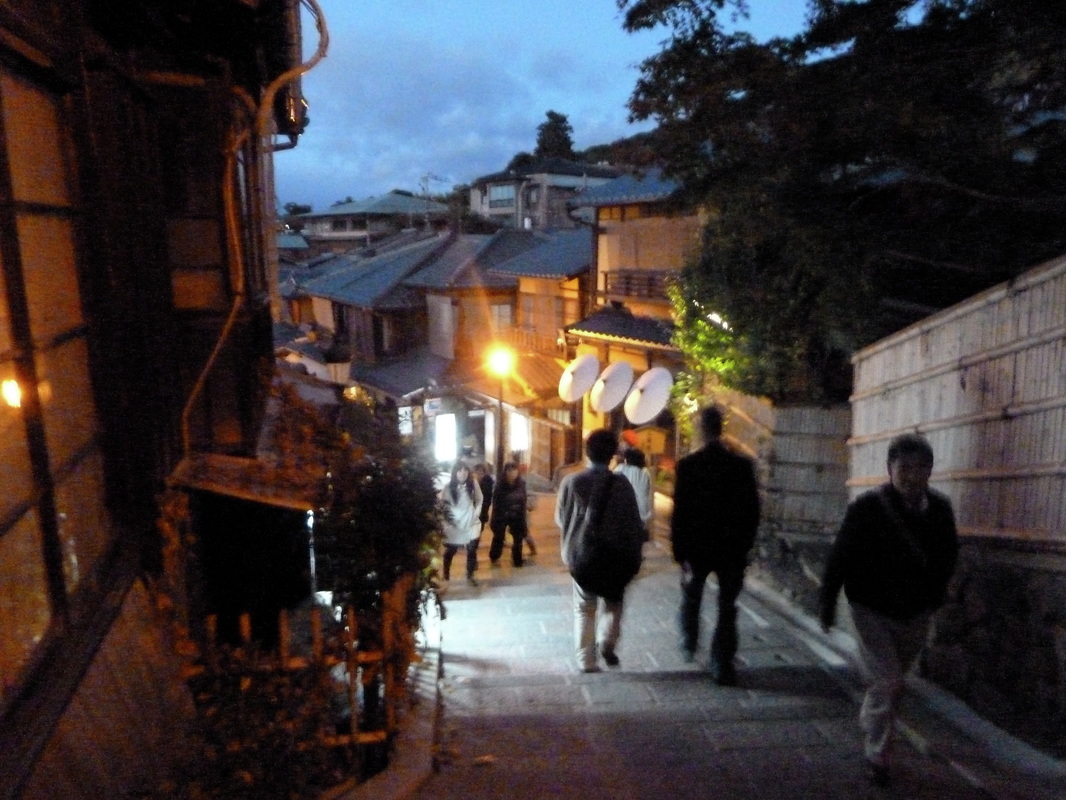
We got on the train to old Kyoto and spent the afternoon trotting around temples. First we went to Sanjusan, a Buddhist temple with a THOUSAND gilt wooden Buddhas guarding some wooden statues in a dark, long building. It was a bit overwhelming. A cool thing for me was how similar the experience was to Catholic cathedrals. Here, too, people lit candles, dropped coins into slots, prayed to saints, and had rosaries. After the temple, we walked the grounds, which oodled with shrines, wells, raked gardens, and fresh orange paint.


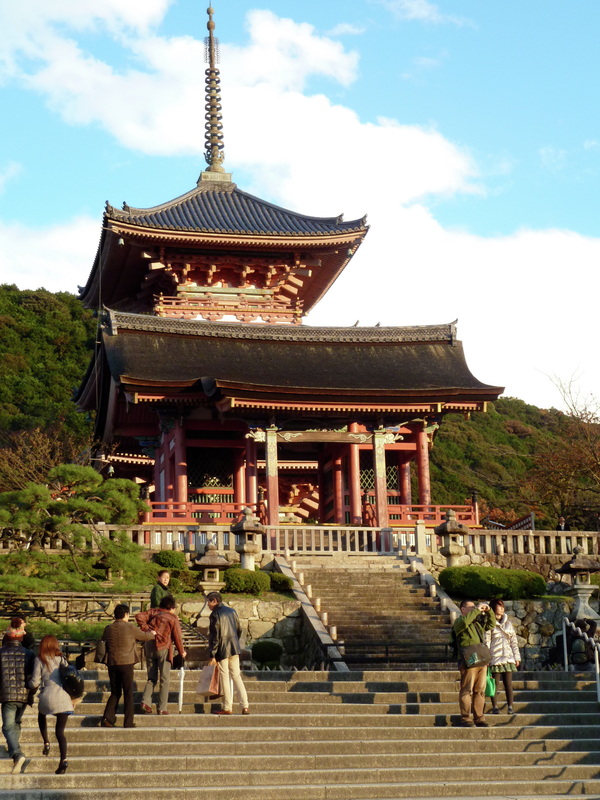
After blah noodles at an udon place, we climbed steep stairs lined with tourist shops to a huge temple complex. I was strongly reminded of the climb to the Sacre Coueur cathedral in Paris, with much the same shops and pilgrims who spent equal time on prayers and trinkets. Ornate pagodas, shrines, temples, and a stage crowded the area. There was a big brass pot you could pray at, and bang with a deliciously resonating effect. Lots of photos, lots of people, lots of happiness. Most of the people looked quite pleased, as did we. Something about the group feeling of pilgrimage, I guess. 


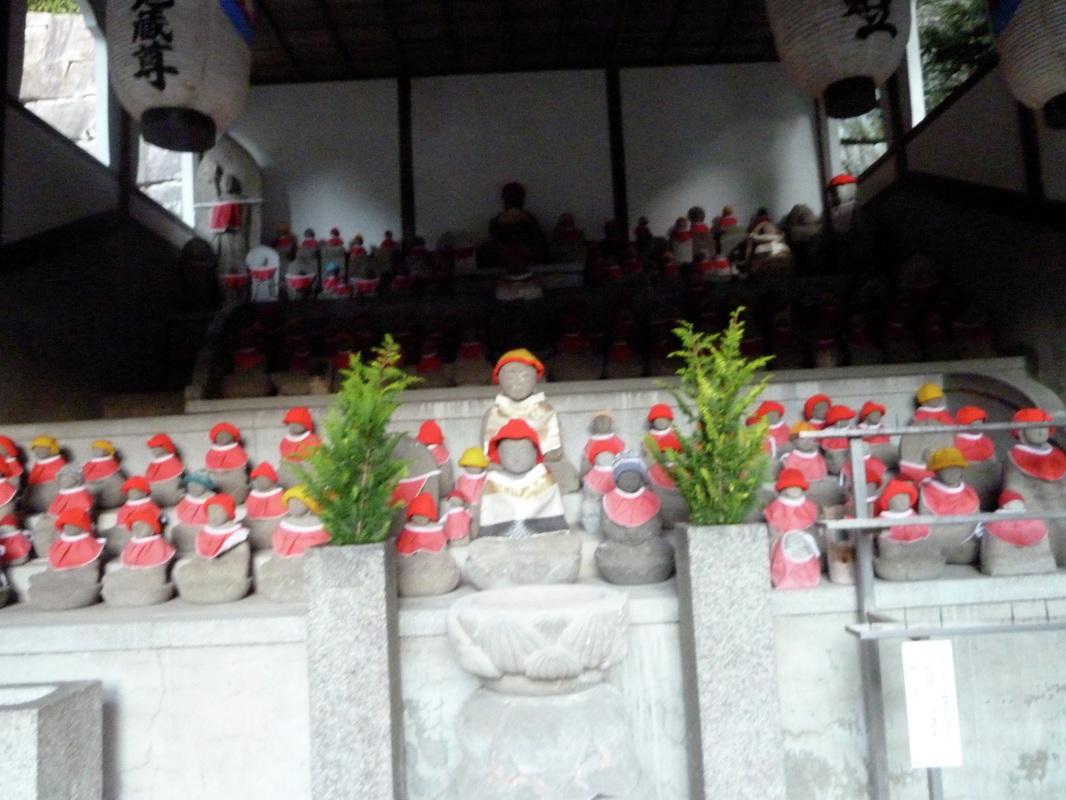
In amongst the larger buildings, there were tiny shrines, guarded by kitsune foxes or stones. There was a hillside with wooden sticks with writing on them, marking donated cherry blossom trees. There was a shrine where people had left stones on all available surfaces. There was a shrine where you washed your hands with water collected from streams of water coming off the roof.  There was a shrine with a row of stones clad in red hats and red aprons. It was a busy and very satisfying kind of religious place.


In the midst of this the zipper on my purse exploded and I spent some angst trying to keep my camera, wallet, and sketchbook from falling out. I don't think there are that many pickpockets here, but still, you don't want to be stupid. We ended up at a canvas purse store, run by one of three brothers who learned their trade from their father. They had different ideas about how to design their product, so now there are three stores, each pretty appealing, and to an unfamiliar eye, not much different. Anyway, the one I settled on is a capacious bag suitable for carrying the kitchen sink along with the camera, wallet, sketchbook, other sketchbook, pencils, and fingerless gloves that I take with me.


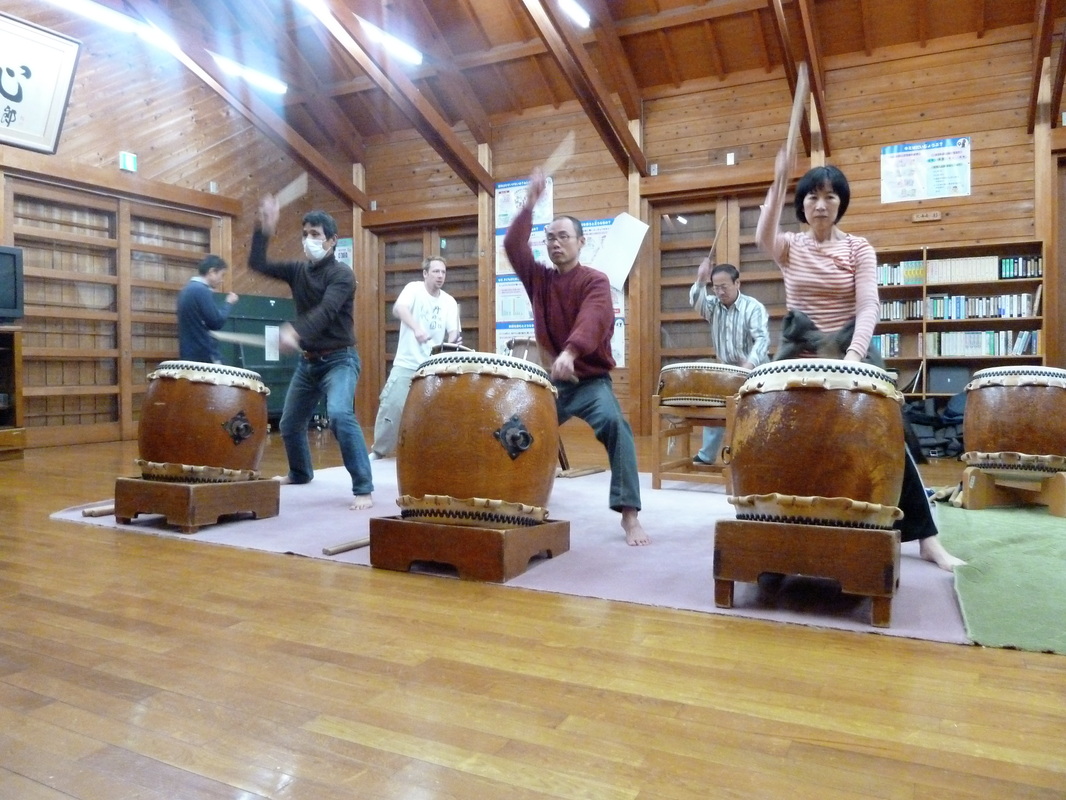
We rushed to the bus, from it to the train, and from the train to the grocery store, where we bought grapes and met Jason. He took us to his weekly taiko drum practice. Here is a link, not of this group, that gives a flavor. I'll replace it with my own clip when I get back to the States. Jason's group is run by the soy sauce guy we met yesterday. He is a stickler for doing it right. The effect is that of a martial art. They really pound on the drums, using dramatic gestures. After a 20 minute performance, so loud our ribcages rattled, we were invited to try as well. 


You hold the stick straight up, then let gravity bring it down and at the last minute, flick your wrist and slam it down on the center of the drum. Soft or faster strokes start from closer to the drum. Camilla, Yayoi, and I learned not only the 8, 4, and 2 beat rhythms, but also a delicious 5-beat one, and then we got to learn the first part of one of the pieces they do. After a half hour of some really serious drum whacking, we were out of breath and our arms were sore. A great workout, and quite satisfying because of the sound, the vibration, and the group high.


Afterwards, we all sat around drinking tea, eating the special black soybeans, and talking about Camilla's education, which, as you might imagine, is inconceivable around here.


We drove home, stopped at a 7-11 to get green tea and pumpkin ice cream, and hung around chatting over ice cream and persimmons. Good night!
0 Comments

Nov 14; Kyoto pottery and soy sauce

11/14/2010

0 Comments

 
This morning we awoke in Jason's tatami room, three futons laid side by side. Cute. Around noon everyone was ready and we drove to a French cafe for brunch. Then we picked up Jason's roommate, Yoshi, and went off to meet with two traditional Japanese artisans.


The first, Hiromi Nishijima, is a potter who specializes in glazes. His showroom is filled with amazing art bowls and vases, each with some kind of interesting glaze effect. When he realized how interested we were, he went into detail about some of the things he does. He collects about as much goldenrod as Jason's car is big, burns it down to ash, runs it through a 60x mesh, and rinses the ash 30 times for 30 days. Add one part in three to a clear glaze and you get ... well, I forget what color it was, but it was beautiful. He's experimented with iron, and found that a small amount gives red, a reducing fire gives blue-grey. At around 8%, you start getting blacks. His friends bring him minerals from around the world, so he has, for example, a bunch of little soy sauce bowls, each glazed with ash from a different volcano. Mt Fuji ash gives olive green, Mt St Helens gives a creamy brown. I asked about wrapping pieces with copper wire, and he said that wouldn't work, but I could try scraping off the green rust, grinding it up, sending it through a 100x mesh, and adding it to a glaze to get green. He also uses various charcoals to run his kiln with, including mangrove. He planted a special kind of tree, sekkai, in his back yard because its leaves are high in SiO2Al3, so you can use them to make a leaf print in the glaze ... exactly how is a secret. 


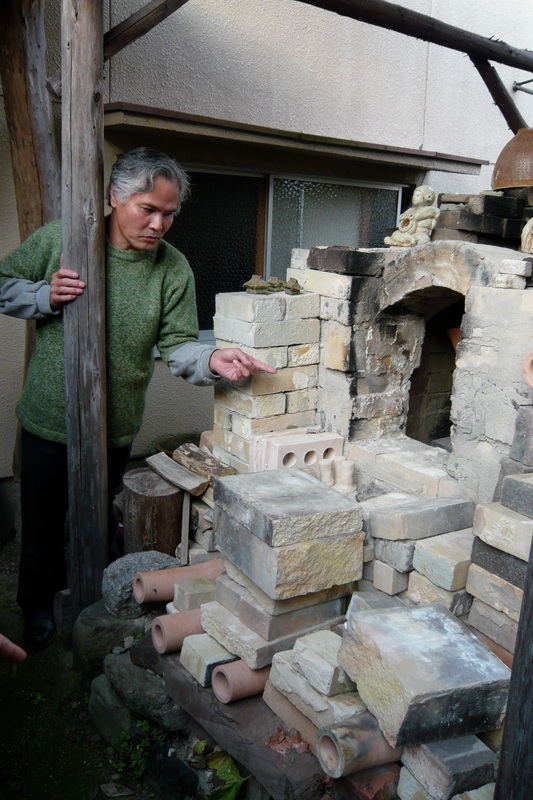
We inspected his coal/coke fired kiln, which sits outdoors. It is on a stone platform, and is basically a fire-brick box. The ware chamber is a 2 foot cube, with a little extra in front where he shovels the coke. Below, there are ceramic tubes through which he can pump air with lawn blowers if he wants the fire to be really hot. The chimney comes out the back, a downdraft chimney with holes for firebrick dampers. 


The workshop has three gas or electric kilns. Shelves with his production work line the walls, but his real interest is in experimenting with glazes. He brought out a couple of museum books showing a particular pot, only one of which is perfect and intact, in a museum in Tokyo. A nobleman brought it back from China 800 years ago, and, if I understood the story correctly, somebody sold a castle in order to own it. THAT is the glaze he wants to be able to recreate. He showed us a series of test bowls. One had one half-centimeter of area where the effect is correct. Potters all over Japan are vying to be able to figure it out. Then, casually, he said, "You guys can have these mistake bowls." Even as mistakes, they're beautiful. We bowed, thanked, and drooled happily.


After tea and chocolate, we left to go down the street to the soy sauce maker. Just opening the door to the shop is like diving into a chocolate factory because of the deep, dark smell. The soy sauce he makes, as you might expect, is richer and fuller than the Kikkoman we get in the States. However, you don't want a soy sauce that is too interesting because it is a condiment, not a meal.


Soy sauce is made from wheat, salt, water, and soybeans. You can use the ordinary white beans, but he also likes to make some from black soy beans, the kind that are grown in the Kyoto mountains. This is too expensive to sell but, like the potter we met earlier in the day, he is an experimenter at heart. Sure, he does production soy sauce to make a living, but what he loves is the art of it.


The fermentation process has to happen in the dark, so we were led into one cave after another. The first one had huge wooden vats with the finished product in it. The staves are about 6 inches across and 6 feet up, and they are held into the barrel shape by woven bamboo and nothing else. Around the corner into the next room, was the well. He uses Kyoto groundwater. Next, there was the boiler, and high above, an ancient 100 year old iron vat on ball bearings that you put the mash into and steam it. After its cooked and sterilized, it goes into a dark room on shallow dishes, where he sprinkles a special yeast on the top. There it ferments for three days.


The mash is then ready to age. The light bulb in the aging rooms is burnt out so we didn't see the commercial aging vats, but his first love is the experimental mashes anyway, which he was glad to show us. They are in about fifteen wooden buckets, busily aging away, from one to four years old. He stirs them every day. "Taste, taste," he invited, and we did, at first nervously, then hungrily. Each bucket had a different taste, from sharp to sweet to chocolaty. There is a big press that extracts the soy sauce, and some pits in the ground through which steam is bubbled to sterilize it so the fermentation stops.

Back in the shop room, we sat down to coffee. Coffee at 7 in the evening. This is normal for Japanese hospitality. Then he presented us each with a bottle of zillion dollar soy sauce, in a purple plastic bag because the color of soy sauce, if it is good, can be described as purple. We parted with good wishes all around. We'll see him again tomorrow night when Jason goes to a taiko drum group he leads.


Now, dinner. While waiting for a table, we visited a palace with a moat, gardens, and an egret perched in a tree. The meal was hearty Italian, served by waitresses in gingham aprons. Delicious, unpretentious, crowded.


At home, we watched "The Miracle Worker," an old movie about Helen Keller learning that words have meaning. Later this month we'll do a session back at Yohane School on the movie, because it talks about language acquisition.
0 Comments

Nov 13; Train to Kyoto

11/13/2010

0 Comments

 
With much bustling and last-minute gift giving and exchanges of business cards, Yayoi, Camilla and I got on the shinkansen train to Tokyo. Two hours later, we switched to the train to Kyoto. The trains are phenomenally fast, quiet, and packed with people. Vendors push food carts around, just like in Harry Potter, but no exploding frogs that I could see. I knit, read, slept, and assiduously ignored my neighbors, who did the same.


In Kyoto, we were met by Jason, a young American textbook rep, who shuttles between Korea, Japan, and the States in the course of his job. He gave us fishburgers and Cokes, piled us into a Land Rover, and drove us to a barbecue an hour and a half away in the mountains.


The parents of a colleague of his built their dream getaway, but then one of them died and the other fell into ill health, so he wants to sell it. The Japanese economy has not been doing well for 20 years, but waiting for better times does not seem wise. So, Jason met his family there along with another colleague who is thinking of buying it. 


All the way up the mountains, little villages were tucked into the folds visible from the highway. There are 7-11s, power stations, ratty looking parking lots, and farmhouses with picturesque tin roofs that cover the thatch underneath. Replacing thatch is necessary every 30 years, and costs 100,000 dollars so there's none left. 


The house we visited was in one such village. It was on a substantial lot, with weeds that included grasses, ferns, and wispy bamboo. There was a big chestnut tree, a mature kiwi vine, and a slice of a bamboo forest, with plants that had trunks six inches across. What looked like sheep poop was scattered about, that comes from wild pig.


We walked up the hill to visit a shrine in a deep, dark cedar forest. Some forest plots were fenced off, and had bamboo and other undergrowth, but the unfenced areas had been grazed down to dirt by the pigs. There was a long set of stairs leading straight up to the shrine. It passes under a red tori, marking the gate between the ordinary and the sacred. It was hung with twisted rice rope, a shimenawa, with paper hanging from it. We saw almost the same kind of arrangement back up north in Sendai, indicating to me that over the years the local Shinto customs have been formalized into an overarching aesthetic. There were a few little buildings with mysteriously sacred things, and then we went back to the barbecue.


People were preparing food in a relaxed way. Thin slabs of wild boar and beef were set on a little charcoal fire outside and moved onto plates, ginko nuts were roasted, and vegetables were chopped for the soup.


The house has two tatami rooms on the left, which are made in the traditional Japanese way with sliding wood and paper doors, tatami on the floor, and a general feeling of wood. A thick low table is in the middle, surrounded by cushions to kneel on. We sat and little plates with food appeared in neverending sequence. The two children are bicultural, and just came back from fall in Davis, CA, where they went to preschool and first grade. They were cheerful, energetic, and much cosseted. 


After way too much food, the businessmen retired to the Western part of the house with their beers to talk, and the women and children stayed behind to chat and roll around on the floor. Camilla's babysitting specialty is to draw and tell stories with children, and that is what eventually happened. One of the men appeared with an amazing ink painting of two dragons done by his grandmother. "Take it," he said, thrusting it at me. "She did hundreds and I don't know what to do with them." Wow. He brought some art books for me to look at, thus both making me happy and freeing the other women to chat in Japanese. This kind of intelligent thoughtfulness is characteristic of all the people we've stayed with. They not only show the kind of hospitality that you would expect from a polite culture, but go several steps beyond to meet individual interests. I hope to learn a tenth of that kind of graciousness!


We almost went to a hot springs on the way home, where fish nibble at the dead skin on your feet, but everyone was too tired. So, with a bathroom and coffee stop at a 7-11, we careened down the mountains, through the narrow streets of Kyoto, and to bed.

0 Comments

Nov 12 in Sendai: Matsushima

11/12/2010

1 Comment

 
We joined Susan for breakfast, then went off with Yayoi to do laundry, have Italian food at Palinka, and drive to Matsushima. On the way we stopped at a second hand shop to look for a suitcase in which to put all the loot Tokiko-san pressed on us last night. Nope. It was an amazing shop, smelling of mold and giving of all signs of a low-end place, except that to American eyes, all the wares were exotic and beautiful. I longingly fingered a $25 kimono, which Yayoi dismissed scornfully, saying that it was for waitresses. There were stacks of painted rice bowls, iron tea pots, Chinese chests, paper lanterns, and bento boxes. You know. Junk.


Matsushima, Ah, Matsushima, Matsushima! 


This is a haiku by Basho, one of my favorite poets. He was right. The place is oodling with holiness. It is a set of small islands with those bloopy looking pine trees on them. Caves have been pickaxed out of the granite so that people can sit in their shelter and meditate. Stones with kanji and statues of Buddhas filled the caves. We wandered around, singing rounds in a tunnel and testing the meditation qualities of various caves. Yayoi and I sketched a portly stone Buddha whose lower body looked like a boulder, while Camilla climbed trees and had old ladies worry volubly at her.


We returned to the hotel to pick up Susan and meet her son, who's paid our hotel bill and said all kinds of kindly things to us. Then Tokiko appeared. She had brought just a few more things we needed to have. A Marimekko gown for Camilla, two kimono for Susan, an obi and jacket for Yayoi. We gasped and ahhed, and then she took us out for sushi. 


The sushi restaurant was a brightly lit place with seats in a semicircle around the kitchen. You could order from a menu or, if you were Tokiko, you could just tell the chef what you wanted and he would try to find that thing, menu or no. She decided we should start with something blue or something shiny, preferably both. Mackerel or sardines, for example. We did, how could we not. Then there was a relentless river of items, all with descriptive words for their texture; something smooth on the tongue but a little tough, something creamy, something grainy with a bite. Tokiko's husband's cousin came in the door, an elderly doctor who decided that Tokiko was not making us eat enough food. He took over and ordered us shellfish sushi, nori soup, pickled daikon, fish eggs, and sea urchin eggs. Eventually he tottered out and Tokoki took up the gauntlet. We ate other things, which blur in the mind. The chef came out with three wooden tablets and had Susan, the famous singer, and Camilla, the model, and me, the artist, sign and date them. He carefully sounded out our names and wrote them on the backs of the tablets in case he wanted to revisit the experience. We finished up with ice cream and bows all around.


Susan and Camilla sat under a tree in the brightly lit promenade, while Yayoi, Tokiko, and I went off in search of a pharmacy. Found it, but the word benadryl had been misspelled to benedryl, and we had a long involved conversation about what it could be until I spotted the mistake. Then a substitute was found, and suddenly Tokiko realized that she had not bought me a present. No problem. I should use face moisturizer twice a day, because the water in Sendai is different than that in America, and my face should become beautiful, not dry like it is now. So she got me some moisturizer and mimed what I should do with it. Problem solved.


When we got back to the others, they were giggling. They'd been accosted by a group of girls who couldn't get over how cute they were. Susan had to sing a bit, but refused to kiss everyone. A drunken man circled them, and another one passed out nearby. This was beginning to get weird, but our arrival stopped the parade of curious people and we all went home.
1 Comment
<<Previous
Forward>>


    Archives

    February 2024
    April 2023
    January 2023
    September 2022
    July 2021
    July 2020
    April 2020
    February 2020
    December 2019
    October 2019
    September 2019
    August 2019
    July 2019
    June 2019
    May 2019
    April 2019
    January 2019
    December 2018
    November 2018
    September 2018
    August 2018
    June 2018
    December 2017
    August 2017
    July 2017
    June 2017
    March 2017
    February 2017
    January 2017
    October 2016
    August 2016
    July 2016
    June 2016
    May 2016
    February 2016
    June 2015
    May 2015
    April 2015
    March 2015
    February 2015
    October 2014
    September 2014
    August 2014
    July 2014
    June 2014
    May 2014
    April 2014
    March 2014
    February 2014
    December 2013
    November 2013
    September 2013
    August 2013
    July 2013
    June 2013
    May 2013
    April 2013
    March 2013
    February 2013
    November 2012
    October 2012
    September 2012
    August 2012
    June 2012
    May 2012
    April 2012
    March 2012
    January 2012
    December 2011
    November 2011
    October 2011
    August 2011
    April 2011
    February 2011
    January 2011
    December 2010
    November 2010

    Categories

    All
    Apple
    Biocities
    Buoys
    Calligraphy
    Curating
    Cyanotype
    Driftwood
    Drum
    Edinburgh
    Florence
    Forest
    Framing
    Hanko
    Illuminated Manuscript
    Japan
    Kimono
    Kos
    Kyoto
    Leeds
    Madrona
    Manhole
    Mind
    Mixed Media
    Museum
    Nature
    Oil Painting
    Painting
    Plants
    Pottery
    Reflections
    School
    Sea Life
    Sendai
    Shoyu
    St Andrew
    St Andrews
    Studio Shot
    Taiko
    Tea Ceremony
    Technology
    Temple
    Tokyo
    Vancouver
    Venice
    Watercolor

    RSS Feed

Powered by Create your own unique website with customizable templates.